Small Martial Arts Tattoos to Get Behind the Year
Reporting from Beijing —
Ma Chao has a foreign request for his customers: Are you certain yous want to practice this?
Sometimes he tactfully sends them away, peculiarly women.
To the horror of his parents, an car manufacturing plant worker and a retired street cleaner from Jilin province in northeastern China, Ma left school at the age of 14 to apprentice with a tattoo master.
Tattoos were long largely spurned in China, perceived equally associated with gangsters, prisoners and criminal offence. Even now, it is rare to encounter tattoos in the street or public life.
"My parents didn't want me to become a tattooist because China is quite bourgeois and at that place's a social stigma," Ma said. "People associate it with criminality. My parents were worried it was bad people'southward business concern. They were worried I might get involved in gangs."
Simply, he insisted, it was similar learning any other skill.
Ma, 26, who entered the trade around 2006, has gained fame within the subculture, earning as much every bit $12,500 a month, an amount unthinkable to his father, who nets $740 a month assembling automobile seats.
Tattoos began to proceeds a creeping popularity around the 2008 Beijing Olympics, with its influx of foreigners. The internet, meanwhile, has helped spread images of tattooed foreign celebrities.
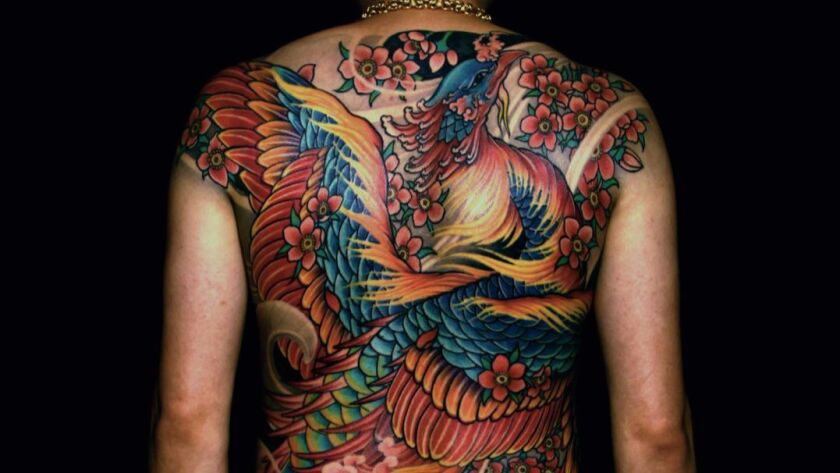
Ma has won awards with his total body tattoos depicting swashbuckling outlaws and heroes from ancient Chinese literature, mythical creatures similar dragons and phoenixes and auspicious symbols such as koi fish.
Ma Chao and his cousin Ma Quanquan run Shi Fang tattoo studio in Beijing.
(Robyn Dixon / Los Angeles Times)
But he still believes sprawling ink of legendary bandits and warriors is not suitable for the female body.
"I only do information technology if it tin be subconscious. I advisedly enquire them to become away and think about it: Will it affect their family or volition their employer react negatively?" He and his business partner, cousin Ma Quanquan, suggest most clients to avoid inking parts of their body that cannot be hidden.
From the outside, the Shi Feng tattoo studio in west Beijing's Xicheng district is an anonymous squat gray edifice without a sign or a light.
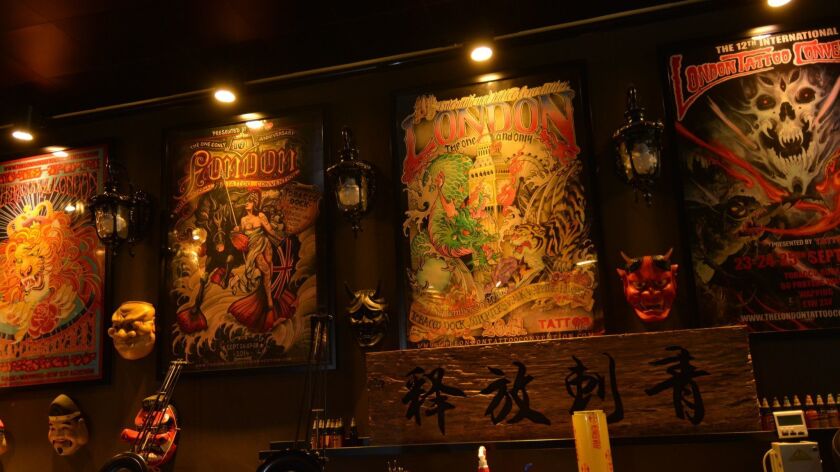
Inside, it feels like a dim man cave with its shiny black and gold tiles, matte black walls, glittering mirrors, gilt-framed posters, demonic grinning masks, a snarling model tiger head, a Chucky horror doll and soldier-straight rows of bottles of the vibrantly colored inks that characterize Chinese tattoo art.
(Ma Chao)
Ma bends silently over his work, advisedly dipping his needle into a pocket-size vial of ink and tattooing gilded scales onto a koi fish outlined in brilliant green.
Every bit the son of migrant workers, he was not eligible to go to a government high schoolhouse in Beijing. He dropped out at 14 knowing his parents could not pay private school fees in the capital. While young, he was distracted in every class except art.
He exudes a tranquillity, shy aura, and rarely sugariness-talks his clients.
He also continues to demonstrate unstinting respect and dedication to his tattoo "master," who taught him the trade — and how to be a decent human being.
"I would serve tea and wine to my master whenever he needed it," he said. "He taught me how to cascade tea, how to pour vino for my elders.
"Information technology was my master who taught me my social philosophy."
He learned how to encourage his customers to endure the pain, especially for full torso tattoos, which, at an 60 minutes a twenty-four hours, can take months to complete.
Tattoo studios take begun to quietly multiply in Mainland china, especially in major cities, and trunk ink has taken hold among rappers and livestreamers, giving it cachet among some young people.
Even and so, China's media watchdog concluding year banned celebrities with tattoos and other depictions of "subculture" from actualization on television. A Chinese TV network expunged Albania's Eurovision entry because of vocalist Eugent Bushpepa's tattoos. In January, when China'due south national soccer team competed in the Asian Loving cup in Abu Dhabi, United Arab Emirates, some squad players wore long sleeves to cover tattoos despite sweltering temperatures.
Even the armed services limit tattoos on artillery and legs to about the size of a dime.
But that's more than the Communist Party allowed when it came to power after Earth State of war Two.
Back then, Mao Tse-tung'due south minions outlawed tattoos.
That meant tattooists had to operate underground, and their clients were often criminals. Gabe Shum, a prominent Malaysian-built-in tattooist who runs the Hong Kong Tattoo Convention and owns Freedom Tattoo studios in Beijing and Hong Kong, says that even today, the industry falls into a gray area: not illegal, but not legally recognized either, and always under the shadow of Communist Party disapproval.
"There'south no license for a tattoo store," he said. "If the government wants to terminate it, they tin can.
"The government could close information technology down tomorrow. Information technology's withal a subculture."
He says Chinese tattooists depict inspiration from the fine brush techniques of antique Chinese paintings, while Japanese artists mimic ukiyo-e woodblock prints of the 18th and 19th century.
In Nippon, tattoos are as well stigmatized: They are banned from hot springs, public baths, beaches and some gyms.
Middlebury College professor Carrie Wiebe, who teaches courses in premodern Chinese literature, has fatigued on those ancient texts for an understanding of early Chinese tattoos. Criminals, slaves and concubines were tattooed, and some indigenous groups tattooed themselves to ward off evil. Such tattoos were stigmatized "as impure, deviant and uncivilized," she writes in one of the few academic papers on the bailiwick. Han Chinese viewed remote indigenous groups with tattooing cultures as "barbarians."
Soldiers who tattooed themselves with oaths of loyalty did and then to show backbone and were depicted in premodern literature as heroic. Works from the 16th century depicted characters with decorative tattoos such as dragons.
Like near Chinese and Japanese tattooists, Ma draws his inspiration from China'southward classical literary works, including the 16th century novel "The Water Margin," well-nigh a twelfth century gang of daredevil hero-bandits, five of them heavily tattooed with dragons or flowers.
The story reached Japan in the 17th century and became immensely popular. Chinese and Japanese tattoos often describe the exploits of these martial arts experts: hard-core drinkers with foul tempers, men who tame wild horses, leap over rivers, slaughter evildoers with cleavers or kill tigers with their bare hands. They have magical powers, terrifying scowls, wild eyes or heads like panthers.
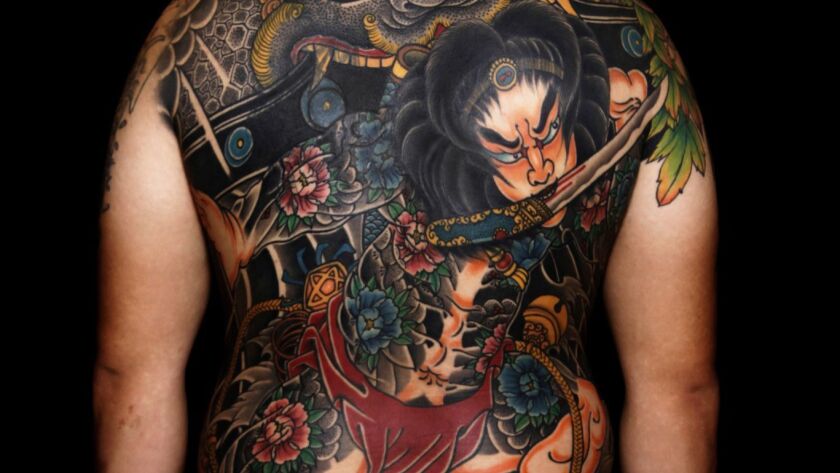
Ma tattooed client Peter Liu'due south entire back with a tattoo of i of the "H2o Margin" gangsters, wild-eyed with a dagger in his teeth.
It took lxxx hours to complete and it won first place in Shanghai'due south tattoo convention.
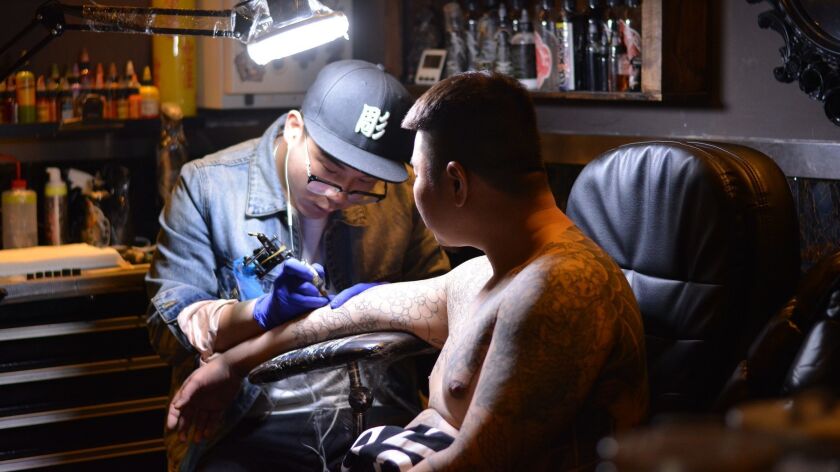
Beijing tattooist Ma Chao draws inspiration from ancient Chinese literature and swashbuckling outlaw heroes, forming a rich tapestry for total torso tattoos.
(Robyn Dixon / Los Angeles Times)
Liu, who got his starting time tattoo at xv, recently returned to the studio to get more on his artillery and chest. Quizzed nearly his love of tattoos and the inspiration behind his inking, he grew annoyed. Perhaps it was the pain.
"I just liked it. It looked good. It was cool," he shrugged. Simply he snapped that his full dorsum tattoo "has no deep meaning behind it. Why do you inquire such stupid questions?"
Ma differs, saying that Chinese tattoos traditionally accept layers of meaning for both the creative person and the customer, and are carefully discussed before the first needle pierces the mankind.
"Chinese tattoos have a lot of unlike cultural elements. Each one of them tells more than one story. Information technology'south non similar in the West: You like motorbikes, you get a tattoo of a motorcycle," Ma says.
"I take inspiration from ancient literature merely add together my own understanding. I love the process of brainstorming and coming upwardly with original ideas."
(Ma Chao)
Ten per centum of Ma's customers are foreigners seeking Chinese-style tattoos.
In the U.Southward., about 40% of people ages 18 to 25 take at to the lowest degree one tattoo, co-ordinate to Pew Inquiry findings.
Ma has no tattoos, because his father forbade him. He also heeds his father'due south communication to exist cautious with customers who seem similar shady types.
"I accept feel with customers from Taiwan or Japan who used to have gangster backgrounds."
Justin Liu, 33, visited the parlor recently to scout his girlfriend go inked. (She was determined to have a Chinese-style koi tattoo.) Liu, an banana director in flick and Tv set, got his beginning tattoo illegally in New Zealand when he was xvi, and was a member of street gangs mainly in Taiwan from then until he was 21.
He has a massive swimming koi on his dorsum, symbolizing wealth.
"You don't get profiled as much here equally dorsum home [in Taiwan for having tattoos]. There, if you have traditional tattoos you'll inappreciably become a chore," he said, referring to tattoos depicting Chinese elements or figures from literature. "When you accept traditional tattoos like dragons and koi fish and demons, they're stereotype gang tattoos. People go them considering they want people to know they're dissimilar and don't mess with them."
He said he took after his father, who was in gangs in the 1970s and '80s and had the scars to show it.
Although he left gangs behind, he retains his passion for Chinese tattoos.
Ma wants to be so famous someday that tattoo artists around the earth know his name and his work.
"It's my passion. I never get tired of drawing."
Just will the Communist Political party always fall in love with the tattoo industry?
"I believe that one day it will be commonly accepted," he said. "People volition see a tattoo every bit a piece of fine art and a fashion argument. It will be normal, and people volition no longer associate information technology with criminals and bad things."
robyn.dixon@latimes.com
Twitter: @RobynDixon_LAT
applegateyousight1936.blogspot.com
Source: https://www.latimes.com/world/la-fg-china-tattoos-20190416-story.html
0 Response to "Small Martial Arts Tattoos to Get Behind the Year"
Postar um comentário